GHI Collaborative Projects
Georgetown Humanities is delighted to feature three interdisciplinary team projects that received GHI “Collaboratory Grants.”
“Entheogenic Worlds: Psychedelics, Healing, and Spirituality Across Cultures”
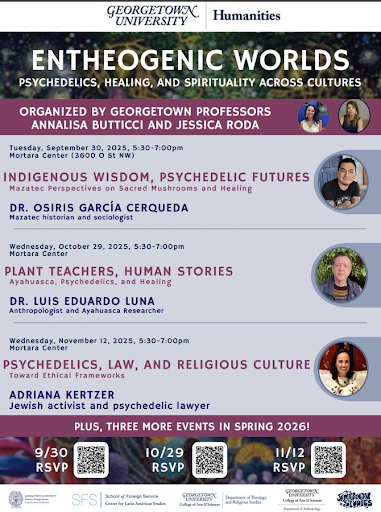
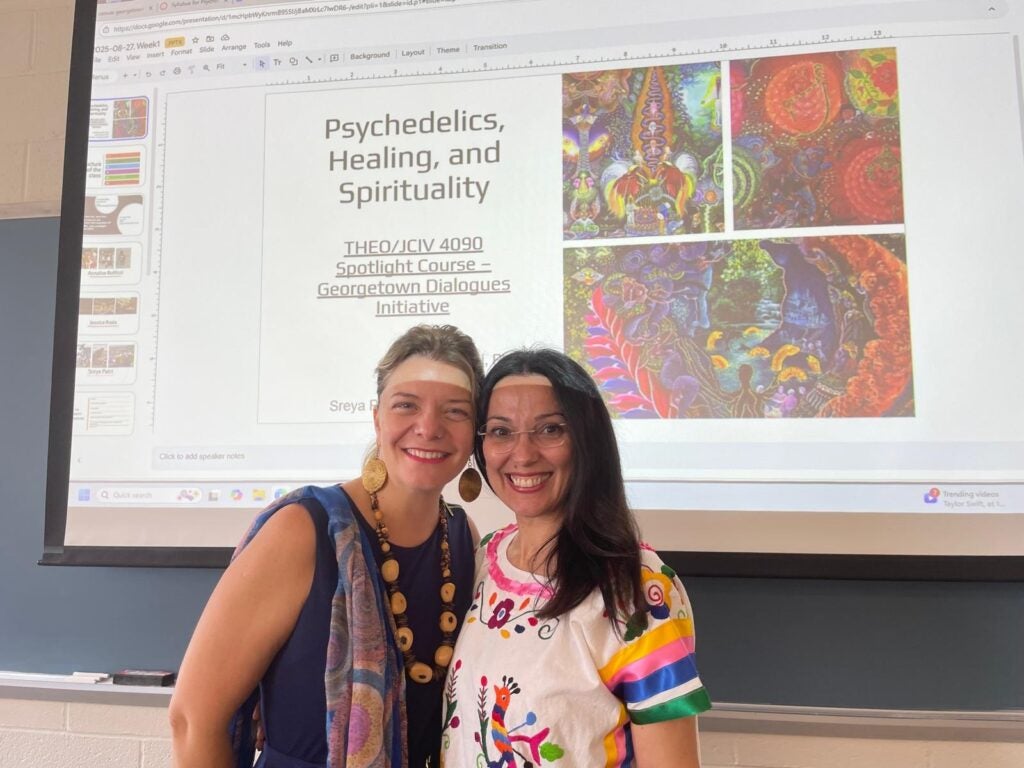
The first half of this yearlong seminar series, organized by Professors Annalisa Butticci (Theology and Religious Studies) and Jessica Roda (Jewish Civilization), has rapidly become one of the most successful interdisciplinary humanities initiatives at Georgetown. Conceived to examine how entheogenic plants, commonly known as psychedelics, are reshaping healing, spirituality, and cultural life across global settings, the series was organized by Professor Annalisa Butticci and Jessica Roda. It brought together international scholars, anthropologists, legal experts, activists, medical researchers, and Georgetown faculty. More than 160 participants registered, with attendees joining from multiple Georgetown departments, other universities in Washington, DC, and the city’s community organizations. The initiative also received generous support from the Center for Jewish Civilization, the Department of Theology and Religious Studies, the Center for Latin American Studies, the Department of Anthropology, and American Studies.
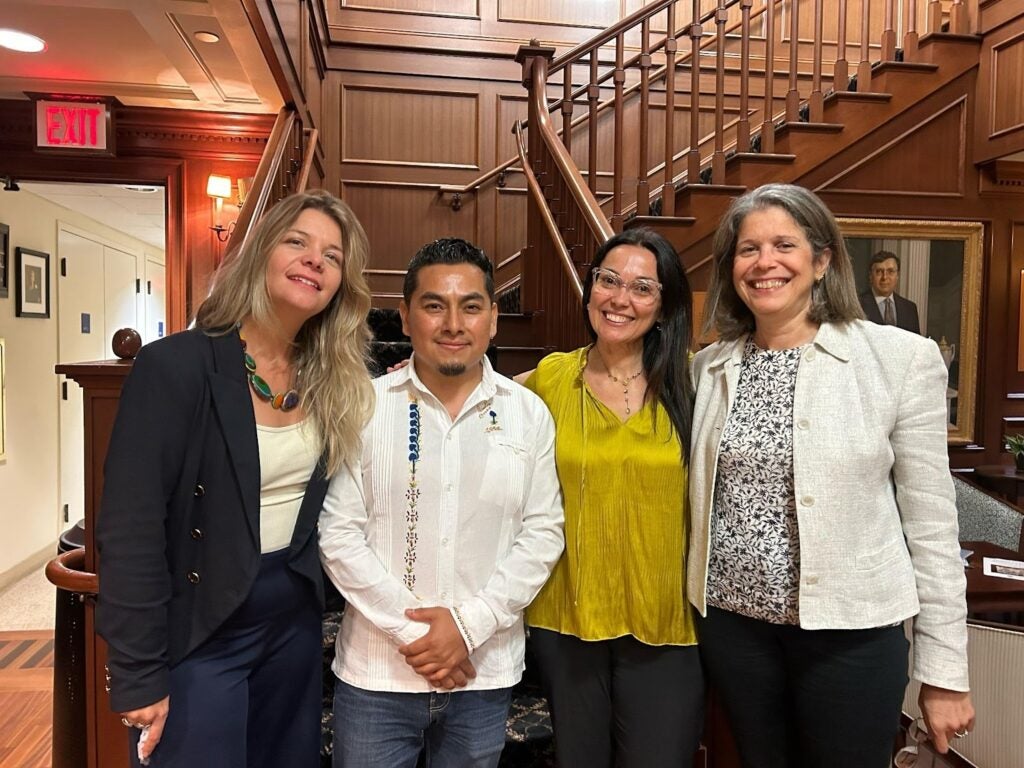
Across the three fall events, the invited speakers were in conversation with Georgetown faculty members Dr. Hakima Amri and Dr. Liliana Duica Amaya, as well as the series organizers Dr. Annalisa Butticci and Dr. Jessica Roda.
The opening seminar, “Indigenous Wisdom, Psychedelic Futures: Mazatec Perspectives on Sacred Mushrooms and Healing,” featured Dr. Osiris García Cerqueda, Mazatec historian and sociologist. His presentation examined Mazatec perspectives on sacred mushrooms and healing, emphasizing the centrality of Indigenous knowledge to both community resilience and contemporary debates on psychedelic futures. The following day, more than ten students lined up for special office hours to continue the conversation on Mazatec history, ritual practice, and the ethical dimensions of research.
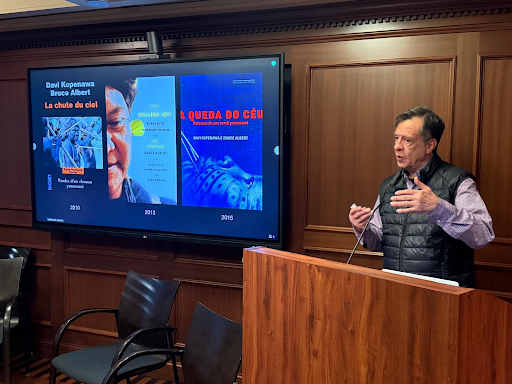
The second event, “Plant Teachers, Human Stories: Ayahuasca, Psychedelics, and Healing,” featured Dr. Luis Eduardo Luna, whose decades of anthropological work on ayahuasca and “plant teachers” have shaped global scholarship. His participation deepened discussions on the ecological, cultural, and healing dimensions of plant teachers, particularly Ayahuasca, enriching the series’s interdisciplinary scope.
The third seminar, “Psychedelics, Law, and Religious Culture: Toward Ethical Frameworks,” featured Adriana Kertzer, a Jewish activist and psychedelic lawyer. Her presentation examined the ethical and legal questions surrounding psychedelics and highlighted the ways Jewish traditions and Jewish psychedelic healing are contributing to emerging psychedelic ecosystems.
Together, these events attracted strong attendance, fostered deep student engagement, and drove cross-departmental collaboration. The spring events will include Dr. Brandon Weiss from the Johns Hopkins Center for Psychedelics and Consciousness, former NHL player Daniel Carcillo on psychedelics, spirituality, and sport, and Madison Margolis on Judaism, psychedelics, and healing.
The “Entheogenic Worlds: Psychedelics, Healing, and Spirituality Across Cultures” series will continue in the Spring semester.
Katrina@20 Symposium
From October 22-24, 2025, a steering committee of Georgetown faculty hosted a national symposium that examined the impacts of Hurricane Katrina and the flooding of New Orleans on memory, culture, history, the environment, and social justice. In 2015, the same colleagues hosted a previous seminar, Katrina@10, also at Georgetown.
Katrina@20 was sponsored by the Georgetown Humanities Initiative and the Earth Commons. Co-sponsors included the History Department, the Sociology Department, the Department of Performing Arts, and the Film & Media Studies Program. The symposium featured events at both of Georgetown’s D.C. campuses.
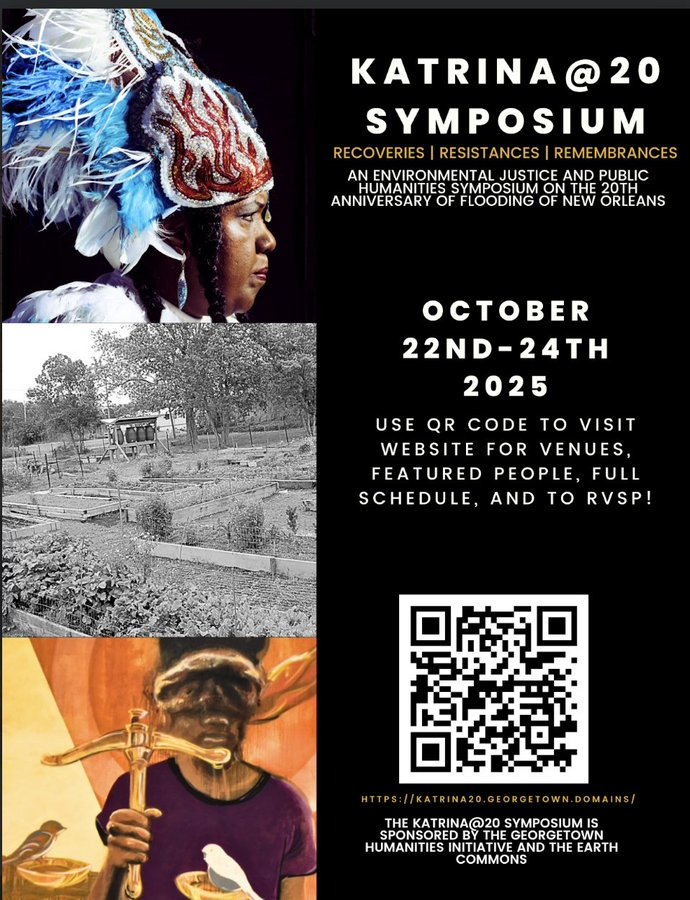
Katrina@20 examined aspects of the legacies and implications of the flood. Through a focus on Environmental Justice, panelists considered how the impacts of Katrina were disproportionate, based on class, race, and status. As the wetlands in Louisiana disappear at an ever-increasing rate, climate change produces rising sea levels, higher temperatures, and greater precarity, especially for working-class Black citizens.
Through the lens of the Public Humanities, panelists sought to understand the causes and consequences of Katrina through interdisciplinary inquiry and discussion. On October 22, K@20 began with a screening of the film, Guardians of the Flame (2025), at 7 PM on both campuses (in the Film Screening Classroom on the Hilltop and in Room 7105 at 111 Mass Ave on the Capitol Campus). After the screening, Georgetown faculty members Anita Gonzalez and Bernie Cook led a discussion between the two audiences.
On Friday, October 24, K@20 continued with two panel sessions in the HFSC Social Room (on the Hilltop Campus). The first panel focused on culture, art, music, and performance and featured NEA Jazz Master and Mardi Gras Indian Chief Donald Harrison Jr.; artist, curator, educator, and Mardi Gras Indian Queen Cherice Harrison-Nelson; and Georgetown faculty members Bernie Cook (American Studies, Film & Media Studies) and Anita Gonzalez (Racial Justice Initiative, Theater & Performance Studies, Black Studies). The second panel focused on community-based activism via land use and urban cultivation and featured artist, theorist, and activist Shana M. Griffin; activist, community organizer, and computer animator Jenga Mwendo; community and economic development organizer Nyree Ramsey; and Georgetown faculty member Yuki Kato (Sociology, Earth Commons). Georgetown faculty member Adam Rothman (History, The Center for the Study of Slavery and its Legacies) offered concluding remarks.
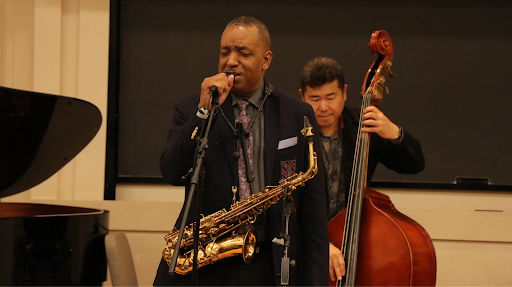
In between the panel sessions on Friday 10/24, Donald Harrison Jr. performed with his combo as part of the Music Program’s Friday Music Series (12:30-1:45 PM in McNeir Auditorium). Harrison played a wide range of jazz (both traditional and modern), blues, and funk. The audience danced as the program ended with a spirited performance of “Hey Pocky A-Way” by The Meters.

On Saturday 10/25, Cherice Harrison-Nelson, Ramona Grant, and Kristiana Rae Colón created a performance installation at the Supreme Court and the U.S. Capitol Building. Harrison-Nelson performed as The Plague Doctor, a mournful figure offering a powerful critique of systemic injustice. Together, Harrison-Nelson, Grant, and Colón performed as Maroon Queens of the Guardians of the Flame, testifying to the importance of community-based Black cultural performance to American history, cultural politics, and social justice. The performances were documented by Nate Findlay (C’27) and Francesca Scovino (C’27), and Cook, Harrison-Nelson, Findlay and Scovino are working on a short film about the performance installation.
Katrina@20 was also featured in the College News.
“What’s Work? Humanistic Approaches to Understanding Work”
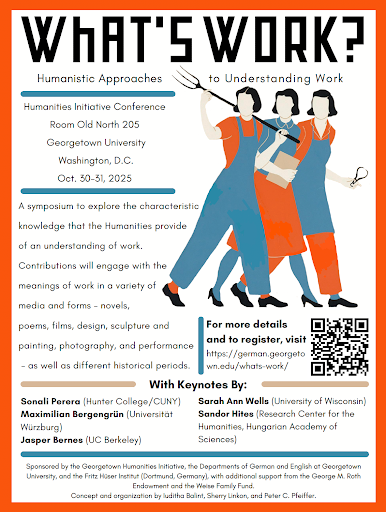
On October 30-31, 2025, the German Department and the English Department convened an international symposium, “What’s Work? Humanistic Approaches to Understanding Work.” The Fritz Hüser Institut in Dortmund (Germany) was an additional sponsor. Five featured speakers and 21 additional presenters from Hungary, Italy, the United States, and Germany explored facets of work from the 19th to the 21st centuries in literature, graphic design, photography, and cinema.
Topics included documentary photography, the relationship between labor strikes and cinema, the role of labor in oppositional literature in Romania during communist times, as well as close readings of work as a theme in Victorian and contemporary German and American literature, depictions of work in television programs like Mister Rogers and Mad Men, and the poetics of housework, among others.
The symposium provided a forum for exchanging ideas among the more than fifty registered participants.
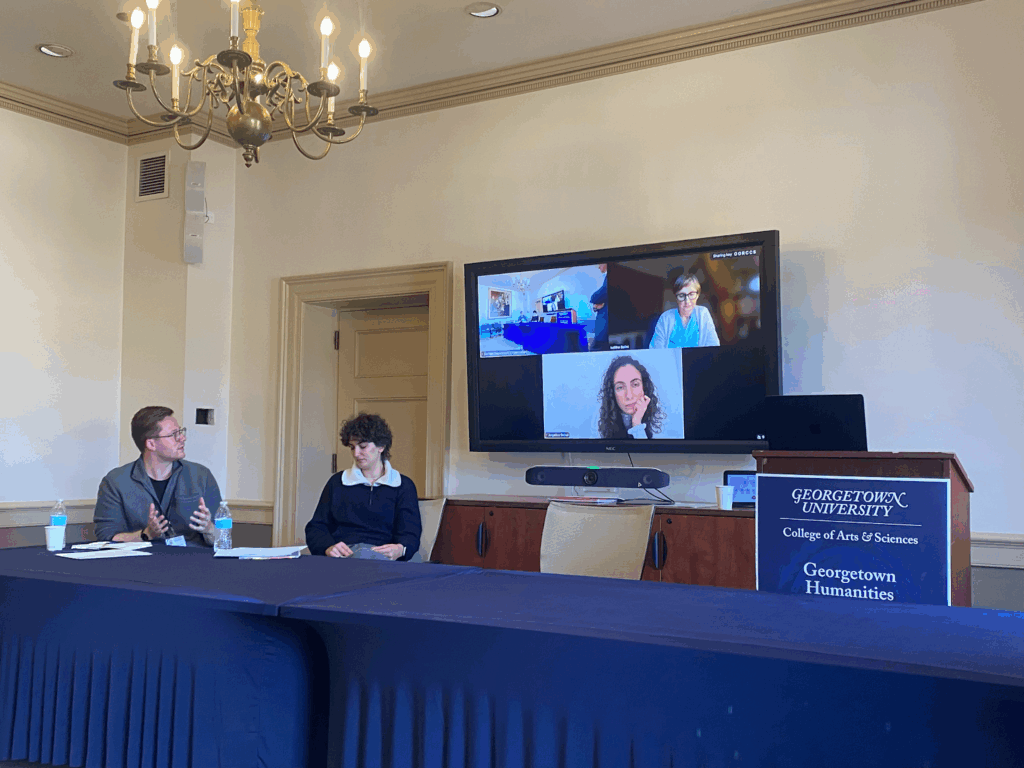
Two days of engaging discussions offered opportunities to articulate how the Humanities contribute to our understanding of work, an aspect of human life that has often been treated as utilitarian and structural. As conference presentations demonstrate, work is a defining aspect of being human, a site for the construction of individual and shared identities, for finding meaning, negotiating power relations, and responding to social, political, and economic issues. By publishing an edited volume of articles based on presentations, the organizers plan to share insights from the symposium with a wider audience.
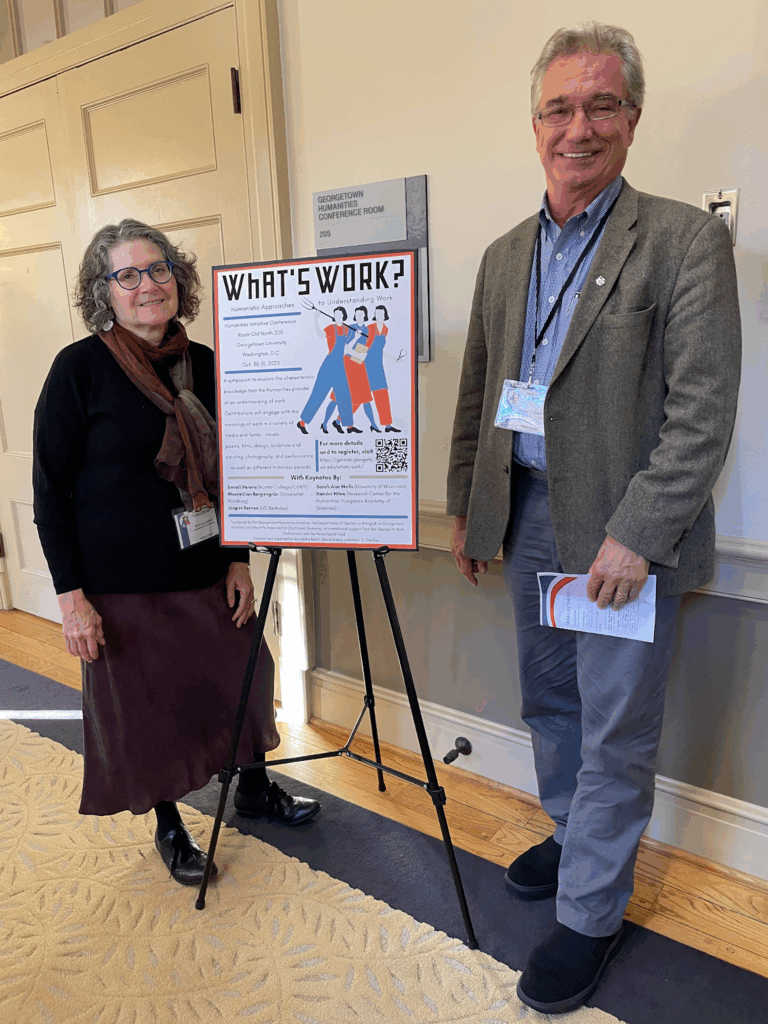
The symposium was co-organized by Iuditha Balint (Fritz Hüser Institut), Emilia Endler (GU German), Sherry Linkon (GU English), and Peter C. Pfeiffer (GU German), with funding from the Georgetown Humanities Initiative, the George M. Roth German Endowment, the English Department, and the Weise Family Fund of the German Department.