Between Differences, Across Divides: A Translation Seminar Series 2026
The yearlong translation seminar series “Between Differences, Across Divides,” co-organized by the Georgetown Humanities Initiative and the Literatures, Cultures, and Language Studies departments, was a great success. It offered a generative space for reframing translation as a dynamic scholarly and creative activity central to the intellectual mission of the humanities.
Featuring renowned speakers working across different linguistic and cultural traditions, the Spring workshops and panels created sustained opportunities for dialogue across departments and disciplines. Faculty and students could engage with translation as a way of reading, writing, and thinking that traverses boundaries and reshapes how we approach literary texts and linguistic and cultural exchanges.
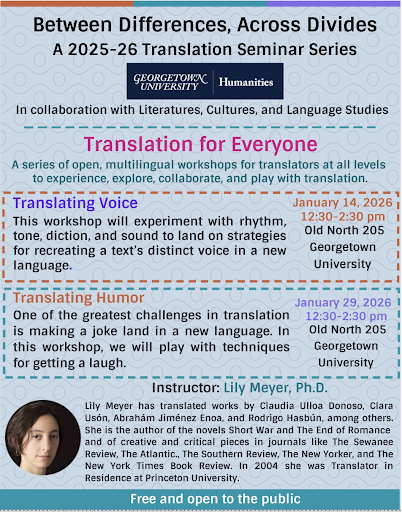
On January 14 and 29, 2026 literary translator, novelist, and critic Lily Meyer offered her last two workshops of the year––”Translating Voice” and “Translating Humor”––which explored the challenges of rendering an author’s narrative presence, tone, wit, and stylistic individuality in another language.
On February 4, 2026, in honor of Black History Month, the interdisciplinary panel “Translating Blackness” brought together three leading scholars and practitioners to examine the role of translation at the intersection of race, language, and cultural politics.
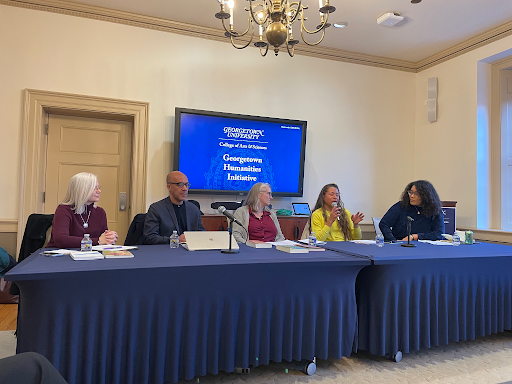
Brent Hayes Edwards (Columbia University), a distinguished scholar of African American and African diasporic literature and translation theory, explored how Black literary and cultural texts circulate across linguistic and national boundaries, and how translation intersects with Black internationalism, archive theory, and the politics of cultural memory. His work on literature, jazz, and translation foregrounds the historical complexity in the production and global reception of Black writing. He has published English‑language translations of essays, poems, and fiction by major Francophone authors and theorists including Édouard Glissant, Michel Leiris, Aimé Césaire, Jacques Derrida, Jean Baudrillard, and Sony Labou Tansi.
Representing literary and publishing practice, Amy B. Reid (PEN America) brought an institutional perspective on the structural and cultural frameworks that shape which Black voices enter English‑language markets. She is an award‑winning literary translator specializing in Francophone African fiction, and has translated works by numerous authors from French into English—among them, Patrice Nganang, Mutt‑Lon, Véronique Tadjo, and, most recently, Haitian-Canadian author Marie-Célie Agnant’s novel Rosa the Alligator (2025).
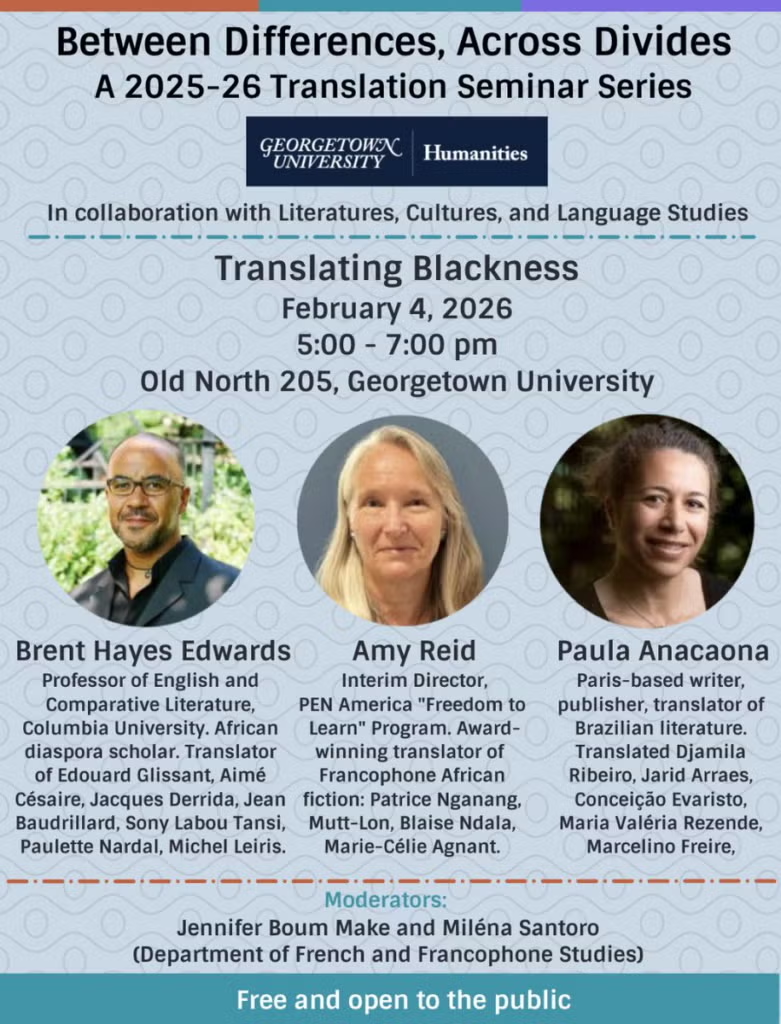
Paula Anacaona, Paris‑based translator, author, and founder of Éditions Anacaona, offered grounded insight from her work translating and publishing Afro‑Brazilian voices often overlooked in mainstream markets. Anacaona has translated into French more than fifty books and built an editorial practice focused on literature by and about racial, socio‑economic, and gendered minorities, shaping how narratives of Blackness and marginality are presented and read in French and beyond.
The panel, moderated by Prof. Jennifer Boum Make and Prof. Miléna Santoro from the Department of French and Francophone Studies, discussed the multiple scales at which translation mediates Blackness––from theoretical frameworks and diasporic poetics to activist publishing practices—and examined how translation both confronts and reshapes literary canons, cultural imaginaries, and global conversations about race, identity, and language.
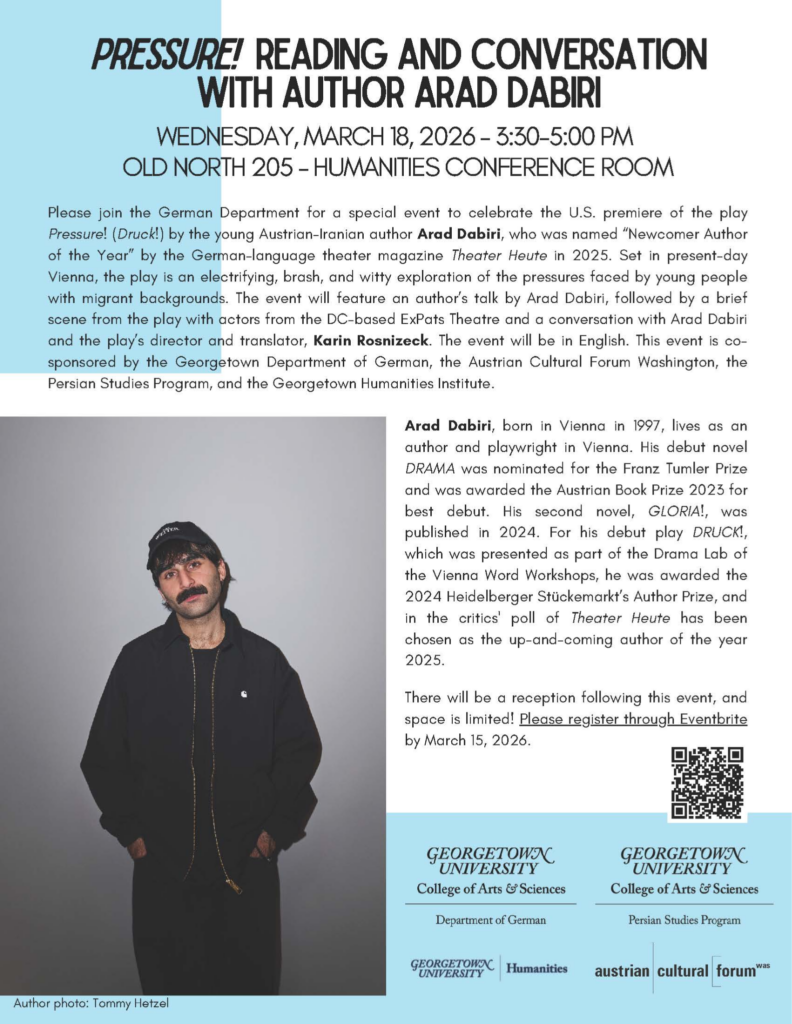
On March 18, 2026, the German Department hosted “Pressure! Reading and Conversation with author Arad Dabiri” to celebrate the U.S. première of the play Pressure! (Druck!) by the young Austrian-Iranian author Arad Dabiri, who was named “Newcomer Author of the Year” by the German-language theater magazine Theater Heute in 2025. Set in present-day Vienna, the play is an electrifying, brash, and witty exploration of the pressures faced by young people with migrant backgrounds.
The event featured an author’s talk by Arad Dabiri, followed by a brief scene from the play with actors from the DC-based ExPats Theatre and a conversation with Arad Dabiri and the play’s director and translator, Karin Rosnizeck. This event was co-sponsored by the Georgetown Department of German, the Austrian Cultural Forum Washington, the Persian Studies Program, and the Georgetown Humanities Initiative.
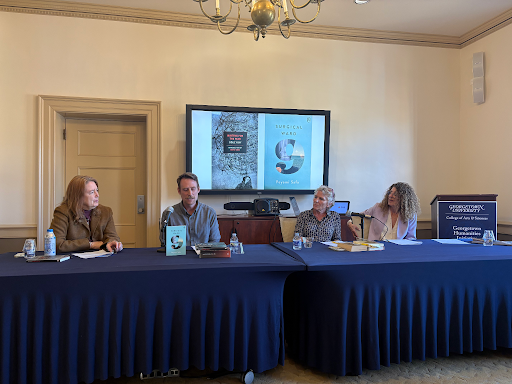
On March 23, 2026, “Translating Literary Giants: Bringing the Past into New Languages” examined the scholarly and ethical challenges of translating canonical literature. Acclaimed translators Virginia Jewiss and Ralph Hubbell drew on their extensive experience translating major works from earlier literary traditions, shaped by philological, formal, and cultural constraints, and complex editorial and critical lineages––Dante Alighieri, Luigi Pirandello, Oğuz Atay, and Peyami Safa, among others.
The panel addressed the tension between historicism and readability, and the role of translation as an act of critical mediation and interpretation that frames how literature is received, taught, and valued across languages and generations.
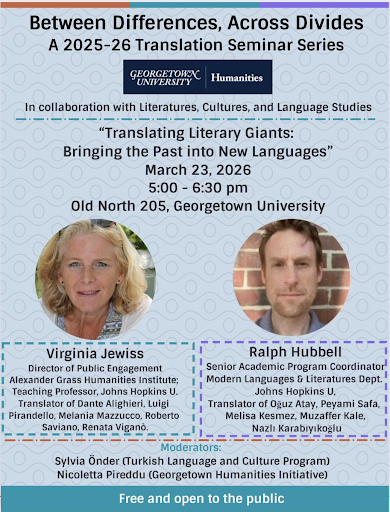
Virginia Jewiss (Ph.D. Yale University) is Director of Public Engagement at the Alexander Grass Humanities Institute and Teaching Professor at Johns Hopkins University. Her research centers on modern and contemporary Italian literature, translation studies, and media adaptation. Dr. Jewiss is a distinguished literary translator whose work spans a diverse range of genres and periods. She has translated canonical Italian texts such as Dante Alighieri’s Vita Nuova and Luigi Pirandello’s Stories for the Years. Her translations also include major contemporary works like Melania Mazzucco’s prize-winning novel Vita, in addition to her Limbo and King Lear; Roberto Saviano’s widely influential nonfiction Gomorrah and ZeroZeroZero; and Renata Viganò’s Agnese Goes to her Death (forthcoming). Beyond literary texts, Dr. Jewiss has translated screenplays for leading Italian filmmakers Paolo Sorrentino, Matteo Garrone, and Gabriele Salvatores, showcasing her expertise in bridging literary and cinematic worlds. Her translation practice exemplifies a commitment to making Italian cultural production accessible to English-speaking audiences across literary and media forms.
Ralph Hubbell is a translator of Turkish literature, writer, and Senior Academic Program Coordinator in the Department of Modern Languages and Literatures at Johns Hopkins University, where he also earned his MFA in Creative Writing. His fiction, essays, and translations have appeared in The Sun Magazine, Words Without Borders, Los Angeles Review of Books, and Tin House’s Lost & Found. Hubbell has translated a range of Turkish authors, from contemporary writers such as Melisa Kesmez, Muzaffer Kale, and Nazlı Karabıyıkoğlu to major literary figures like Oğuz Atay and Peyami Safa. His book-length translation of Atay’s Waiting for the Fear (NYRB Classics, 2024) introduces a landmark modernist short-story collection to English readers, and his forthcoming translation of Safa’s 1929 novel The Ninth Surgical Ward brings a canonical Turkish work of psychological fiction to a new audience. Hubbell’s translations reflect a commitment to amplifying both contemporary and historically significant voices, expanding the presence of Turkish literature across languages and generations.
The panel was moderated by Prof. Sylvia Önder (Director of the Georgetown Turkish Program) and Prof. Nicoletta Pireddu (Director of Georgetown Humanities and Professor of Italian and Comparative Literature).
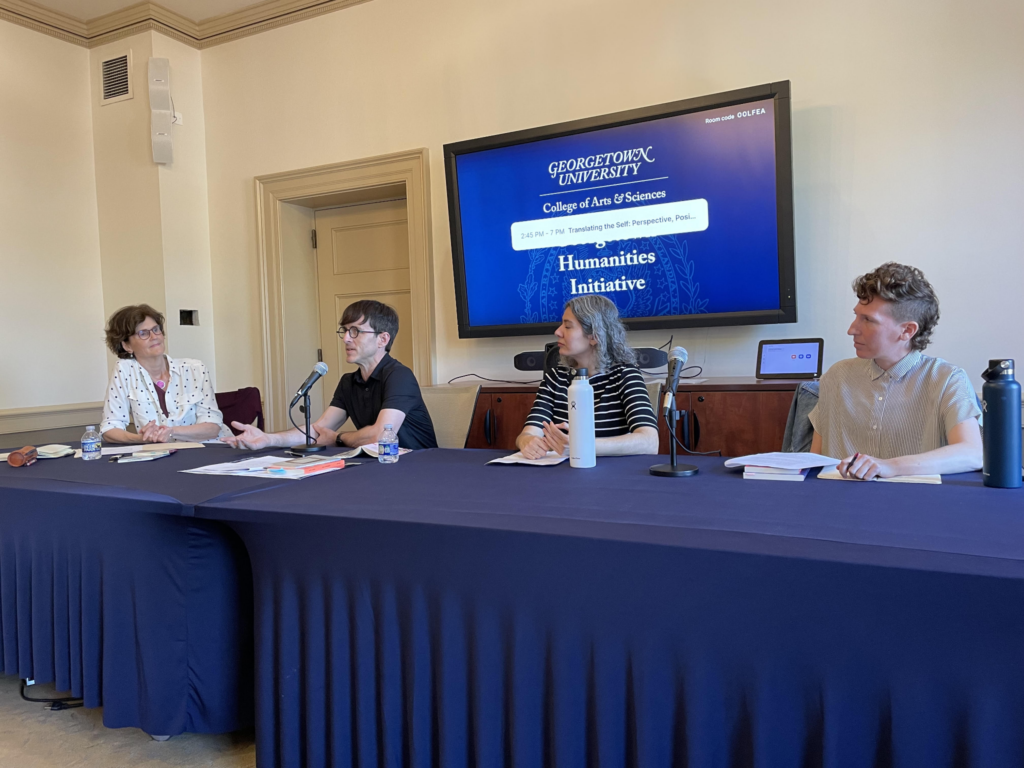
On April 16, 2026,“Translating the Self: Perspective, Positionality, Alterity” featured two distinguished literary translators engaged in the ethics and politics of translating identities across languages and cultures.
Kurt Beals is Visiting Associate Professor of German Studies and Humanities Fellow in Literary Translation at the University of Richmond. He has translated a wide range of works from German into English, often involving questions of selfhood and identity–among them Jenny Erpenbeck’s Things that Disappear (2025) and Not a Novel: A Memoir in Pieces (included in World Literature Today’s 75 Notable Translations of 2020), Erich Maria Remarque’s anti-war classic All Quiet on the Western Front (2025), and Hermann Hesse’s classic novel The Steppenwolf (2023).
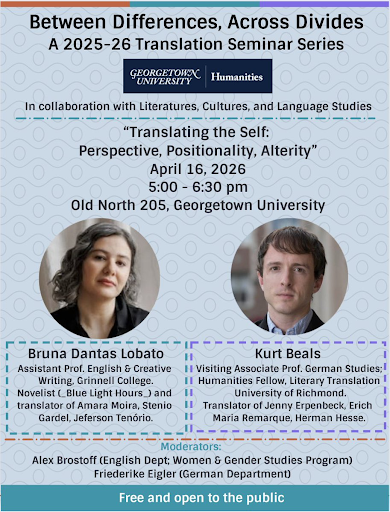
Bruna Dantas Lobato is Assistant Professor of English and Creative Writing at Grinnell College. She has translated essays and novels by Brazilian authors revolving around the search for the self–among them, Amara Moira’s So What if I Am a Puta, Stenio Gardel’s The Words that Remain, Jeferson Tenório’s The Dark Side of Skin. She has also published the semi-autobiographical and semi-autofictional novel Blue Light Hours (2024), and creative fiction in The New Yorker, Guernica, A Public Space, The Dial, and The Common. She has been recognized with the 2023 National Book Award for Translated Literature, an English PEN Translates Award, and fellowships from MacDowell, Yaddo, and Jentel.
Beals and Dantas Lobato were joined in conversation by Prof. Friederike Eigler (German) and Prof. Alex Brostoff (English and Women & Gender Studies).
Daniel Mendelsohn, “What’s the Greek Word for ‘Picnic’?”: A Guided Tour of the Translator’s Task”
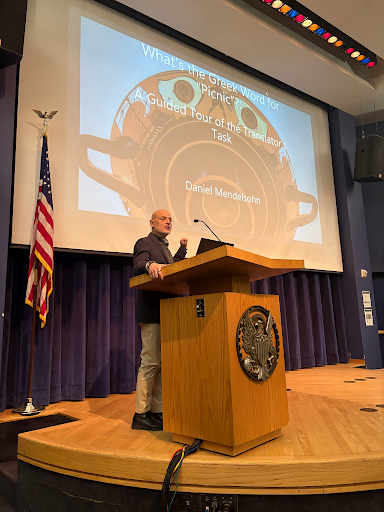
The plenary lecture of the translation series was organized by the Department of Classics and featured prize-winning author and translator Daniel Mendelsohn. On February 23, 2026, just a few months before the upcoming release of Christopher Nolan’s film version of Homer’s Odyssey, Mendelsohn gave the fascinating talk “What’s the Greek Word for ‘Picnic’?”: A Guided Tour of the Translator’s Task,” about his translation of the Homeric poem published by the University of Chicago Press in 2025.
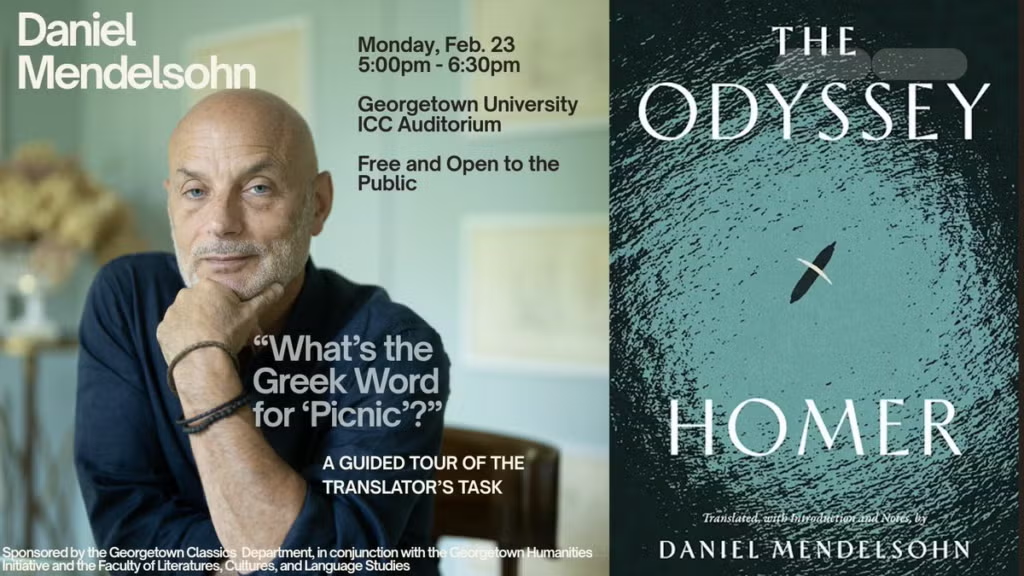
Mendelsohn illustrated his own method and practice of translation, demonstrating how different translators of the Odyssey (there are many versions!) approached the Homeric language and meter in distinct ways. His explanations of his own choices, whether in relation to rare words whose precise meanings sometimes escaped even ancient readers, or to the repeating phrases that pervade Homeric epic, offered deep insight to the poem and cultural dynamics that inform it. His love for language, whether it be from the perspective of rhythm, etymology, tone, or some other aspect, shone through and deeply engaged the large audience.
In keeping with the series’ aim to allow members of our community hone their own translation craft, Mendelsohn also visited an undergraduate advanced Greek course on the Odyssey, where he discussed with students the fine mechanics of translating Homeric Greek.
Working on “Between Differences Across Divides” has been truly energizing. The exciting collaborations across departments fostered a rich intellectual community both within and beyond Georgetown that will continue to inspire future synergies in research, teaching, and public humanities work.
We are especially grateful to Georgetown University’s Office of the Vice President for Global Engagement for supporting our series with a Global Humanities Faculty Seminar Grant.