2025-2026 Humanities Initiative Grant Recipients
We are pleased to present the work supported through our Georgetown Humanities Initiative grants. Collectively, these projects showcase the breadth, originality, and enduring significance of humanities research, highlighting innovative scholarship, collaborative exploration, and the development of transformative book-length studies.
Book Manuscript Workshop Grants
Kyle Shernuk (East Asian Languages and Cultures), Sinoscapes: Chineseness, Ethnicity, and Identity at the Millennial Turn

With the support of a Georgetown Humanities Initiative Book Manuscript Workshop Grant, Assistant Professor Kyle Shernuk hosted a five-hour workshop on 28 May 2026 for his book manuscript, Sinoscapes: Chineseness, Ethnicity, and Identity at the Millennial Turn. Surveying writers, texts, and tales from and about the People’s Republic of China (PRC, China), the Republic of China (ROC, Taiwan), and Malaysia—part of Chinese studies nanyang or South Seas imaginary—the manuscript traverses distinct political and cultural borders to investigate how such disparately produced Chinese-language literatures might suggest a shared vernacular for generating identity and difference across the Sinosphere. Taken together, this monograph queries the Chineseness of “Chinese” studies and reimagines the future of the field to be one defined by unanticipated connections, common yet diverse forms of community, and a plurality of ways for imagining Chineseness around the world.
The grant enabled Professor Shernuk to bring two visiting scholars to campus for the workshop. Carlos Rojas is Professor of Chinese Cultural Studies; Gender, Sexuality, and Feminist Studies; and Arts of the Moving Image at Duke University, and his research focuses on issues of gender and visuality, corporeality and infection, and nationalism and diaspora studies. EK Tan is Associate Professor of Comparative Literature and Cultural Studies in the Department of English and Asian and Asian American Studies at SUNY Stony Brook University. He specializes in the intersection of Anglophone and Sinophone literature, cinema, and culture from Southeast Asia, postcolonial studies, diaspora studies, film theory, queer Asian studies, and world literature and cinema.
Prof. Shernuk plans to submit the final, revised manuscript in September 2026. We look forward to celebrating the publication of his book.
Individual Research Grants
Titilola Halimat Somotan (African Studies, School of Foreign Service), Building West African Cities: A History of Housing Construction and Safety in Lagos Nigeria from the 19th-century to the Present

A Georgetown Humanities Initiative Individual Research Grant supported Prof. Somotan’s research for her second book project, Building West African Cities: A History of Housing Construction and Safety in Lagos Nigeria from the 19th-century to the Present, which examines how building collapses transformed urban landscapes, construction practices, and policies in Lagos, Nigeria, in the last two centuries.
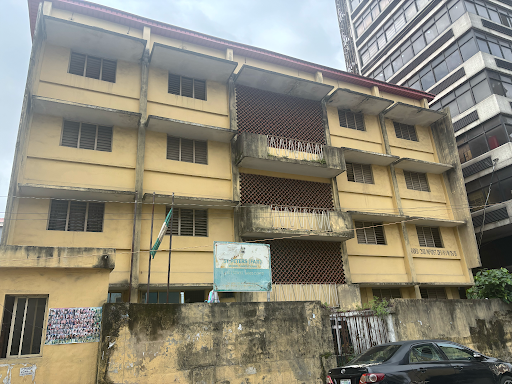
She traveled to the United Kingdom and Nigeria to collect primary sources related to the collapse of the kindergarten building at St. Peter’s (Anglican) Primary School on Lagos Island in August 1955. The building collapse killed eight students and injured twenty-five others. This unprecedented tragedy prompted the British colonial government, in collaboration with Nigerian political leaders, to inspect existing schools and construct new educational buildings, many of which remain in use today. In addition to uncovering archival materials on construction practices in colonial Nigeria, Prof. Somotan interviewed former students who survived the 1955 building collapse. Their memories provided critical insights into school design, the everyday use of educational spaces, and the long-term human impact of architectural failure.
She is currently preparing a journal article that examines changes in school architecture before and after the St. Peter’s Primary School collapse.
Tania Gentic (Spanish and Portuguese), Geographies of the Ear: The Cultural Politics of Sound in Contemporary Barcelona
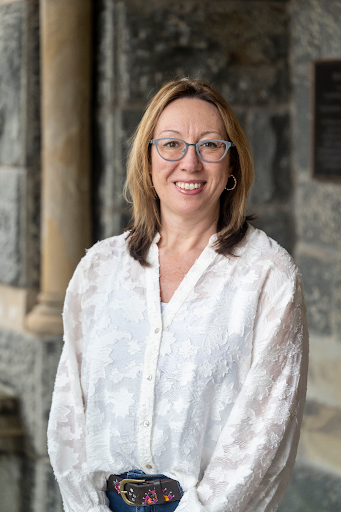
A Georgetown Humanities Initiative Individual Research Grant provided Professor Gentic with funds to cover editing and indexing costs associated with her second monograph, Geographies of the Ear: The Cultural Politics of Sound in Contemporary Barcelona (Durham: Duke UP, 2025).
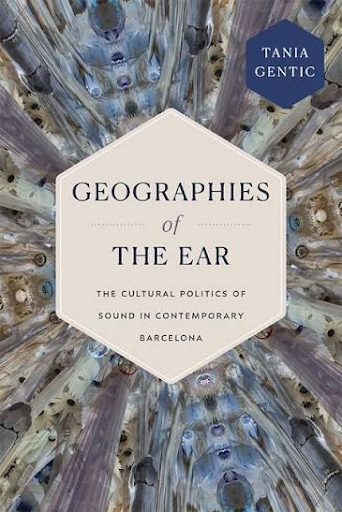
In this book, Prof. Gentic examines the language and soundscape of post-Franco Barcelona to listen for the remnants of a globalized colonial ear. She theorizes “echoic memory” to understand how sound circulates from the past to the present—and from neighborhood to nation to globe—to trace how sonic practices produce and contest modernity, community identity, and democracy. Focusing on migrant and tourist accents, free radio stations, punk music, drag performances, and anti-gentrification protests, Prof. Gentic shows how the underground sounds in Barcelona complicate a modernizing aural imaginary of place. By thinking through the auralities present in literature, fanzines, comic books, documentary films, television, and print media, popular music, public protests, and even everyday conversation, Gentic outlines the difficulties of considering the contemporary city as either the product of a monolingual national identity or a lived space easily circumscribed by geographical categories such as North, South, East, or West.
Collaboratory Grants
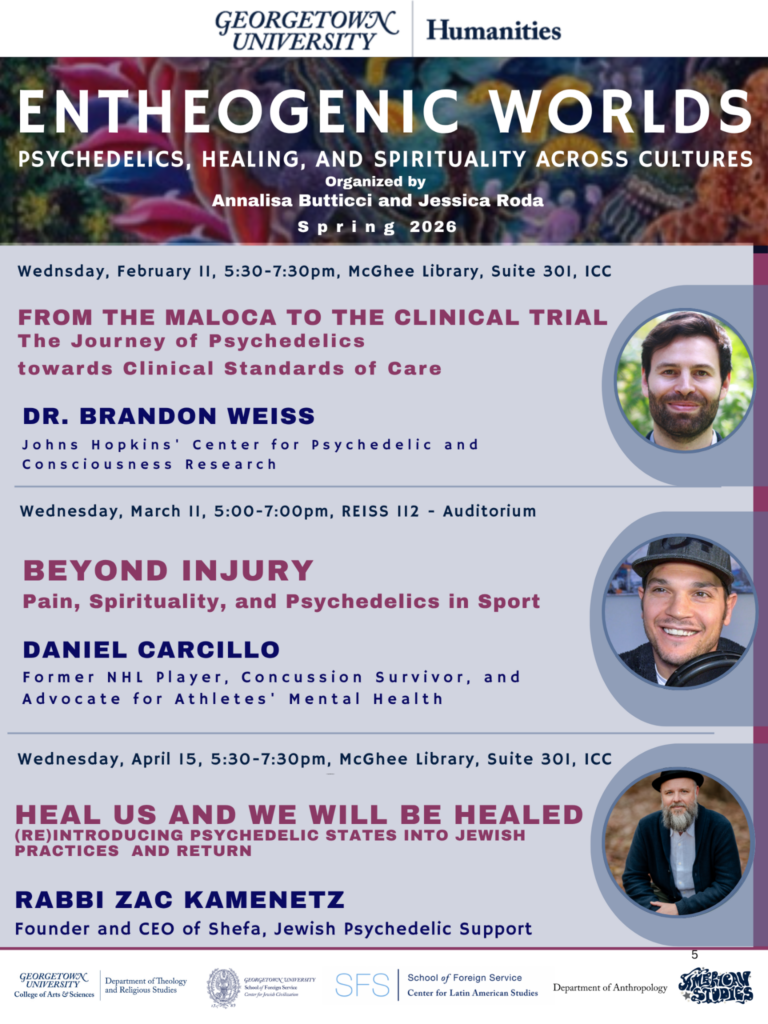
Annalisa Butticci (Theology and Religious Studies) and Jessica Roda (Jewish Civilization), “Entheogenic Worlds: Psychedelics, Healing, and Spirituality Across Cultures, Part II, Spring 2026”
The Spring semester of “Entheogenic Worlds: Psychedelics, Healing, and Spirituality Across Cultures” confirmed the strength and urgency of the yearlong seminar series organized by Professors Annalisa Butticci and Jessica Roda with the support of a Georgetown Humanities Initiative Collaboratory Grant. Building on the remarkable response to the Fall events, the Spring program continued to draw strong attendance from Georgetown students, faculty, and colleagues across multiple the Center for Jewish Civilization, the Department of Theology and Religious Studies, the Center for Latin American Studies, the Department of Anthropology, and American Studies, as well as participants from broader Washington, DC intellectual, spiritual, and civic communities. The series became a sustained forum for examining how psychedelics are transforming contemporary conversations about spiritual life, healing, clinical care, athletic injury, and religious returns.
A distinctive feature of the Spring seminars was their continuing impact beyond the events themselves. Students returned to class discussions with questions raised by the speakers, and many incorporated the seminars into their written reflections. The series became deeply integrated into the intellectual life of the semester. It offered students a public humanities setting in which scholarly research, lived experience, and clinical inquiry could be held together with seriousness and care.
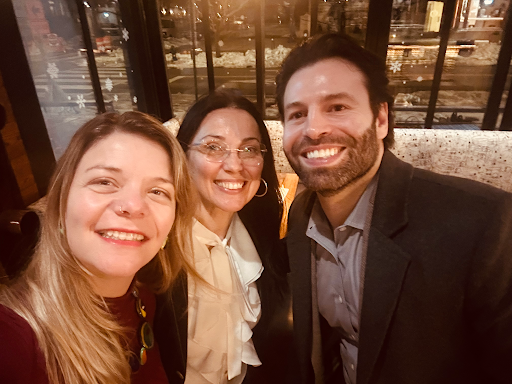
The first Spring event featured Dr. Brandon Weiss of the Johns Hopkins Center for Psychedelic and Consciousness Research, whose lecture, “From the Maloca to the Clinical Trial: The Journey of Psychedelics towards Clinical Standards of Care,” offered a rigorous and compelling bridge between ceremonial ayahuasca practice and contemporary psychedelic science. His presentation moved from Shipibo-Conibo healing traditions and ayahuasca ceremony to clinical research on psychedelics and veterans’ PTSD. The talk gave students and faculty a powerful model for thinking critically across Indigenous healing frameworks and biomedical research on personal transformation and healing.
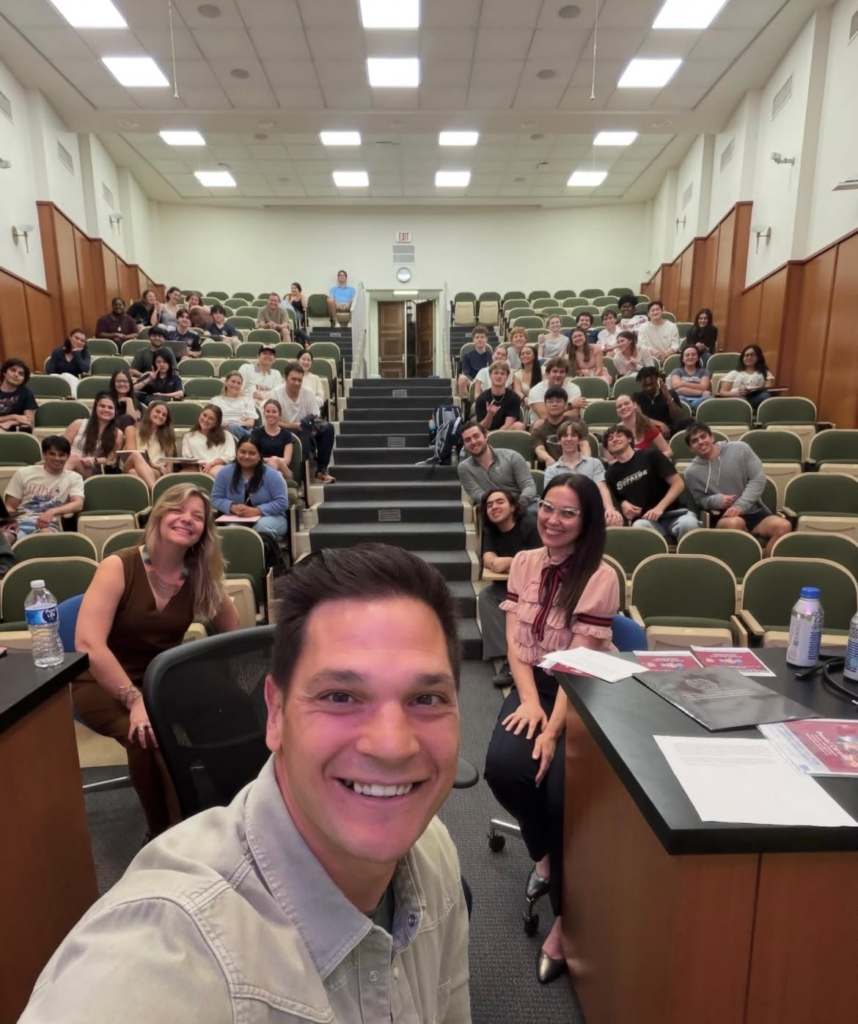
The second Spring event, “Beyond Injury: Pain, Spirituality, and Psychedelics in Sport,” featured Daniel Carcillo, a former NHL player, two-time Stanley Cup champion, concussion survivor, and mental health advocate. Carcillo’s visit drew an especially large number of student-athletes, making visible a strong campus interest in performance, brain injury, and spiritual healing in sport. His public work centers on traumatic brain injury, post-concussion suffering, and his turn toward psilocybin as part of a search for recovery after conventional treatment failed to provide lasting relief. His lecture opened an unusually honest conversation about elite athletic culture and the need for new approaches to spirituality and mental health among athletes.
The final Spring seminar, “Heal Us and We Will Be Healed: Reintroducing Psychedelic States into Jewish Practices and Return,” featured Rabbi Zac Kamenetz, founder and CEO of Shefa: Jewish Psychedelic Support. Kamenetz offered a deep reflection on sacred plants, healing, religious return, and Jewish spiritual practice. Shefa’s work centers on creating spaces for healing and self-discovery in community by integrating Jewish wisdom with psychedelic practices. His talk expanded the series’ attention to the religious dimensions of psychedelic experience, asking how inherited traditions can guide contemporary practices of integration, meaning-making, and repair.
The Spring events demonstrated that “Entheogenic Worlds” has become one of Georgetown’s most generative interdisciplinary spaces. The series brought together anthropology, theology and religious studies, Jewish studies, medicine, psychology, sport, trauma studies, and public humanities. It also showed that students are seeking serious, ethically grounded conversations about psychedelics, conversations that move beyond stigma, spectacle, and purely clinical narratives. Through its strong attendance, cross-departmental reach, public engagement, and sustained influence on teaching and student writing, “Entheogenic Worlds” has established a significant foundation for future programming on psychedelics, healing, spirituality, and culture at Georgetown.